The California Gold Rush was sparked by the discovery of gold in the Sacramento Valley on January 24, 1848.
January 24, 1848
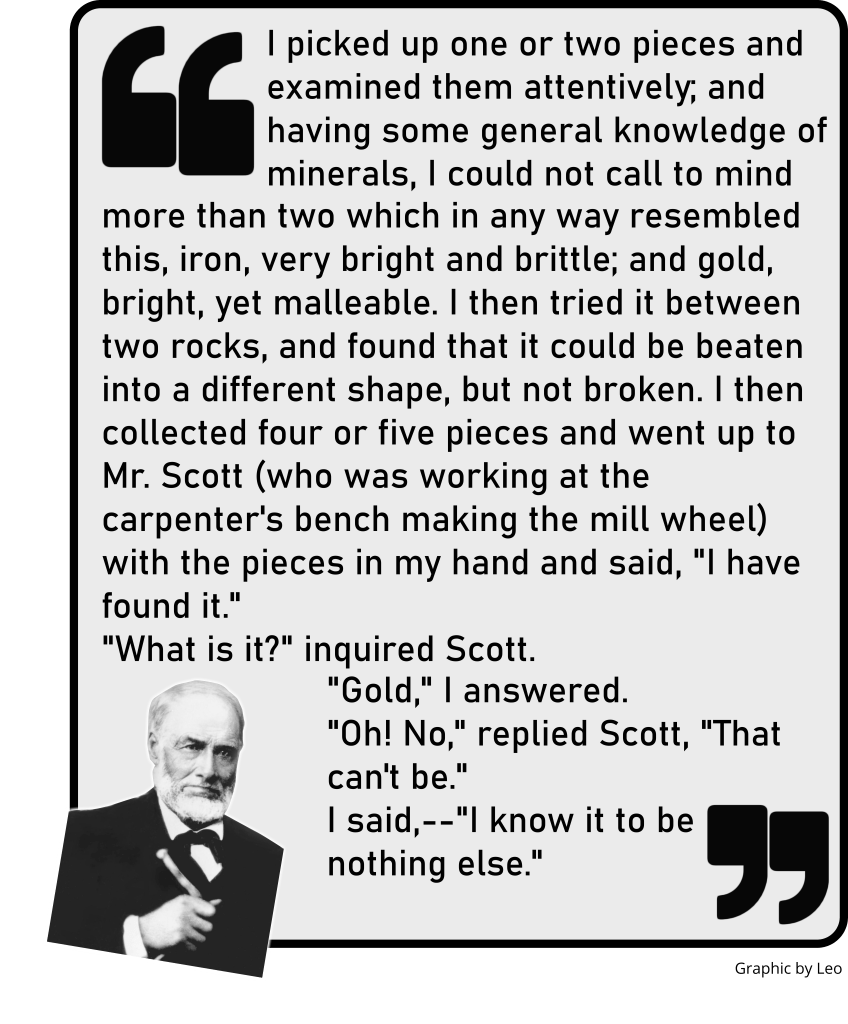
That morning, a carpenter called James Wilson Marshall spotted flakes of gold in the American River at the base of the Sierra Nevada Mountains near Coloma, California. Marshall was working to build a water-powered sawmill owned by a wealthy landowner called John Sutter.
Marshall later described his historic discovery:
March 1848
Sutter tried to keep the find a secret as he feared all his land would be dug up, but word got out, and by March, it was being reported in newspapers.

A Californian newspaper from March 1848 June 1848
By mid-June, about three-quarters of the male population of nearby San Francisco had left town for the gold mines. At first, prospectors retrieved the gold from streams and riverbeds using simple techniques, such as panning. Later they had to mine underground. There was no law about who owned the gold: it was basically ‘finders keepers’. Sutter was right about his land: it was ruined and his agricultural business failed.
August 1848
By August there were 4,000 miners in the area and people kept coming, travelling from all over America and beyond (such as Hawaii, Mexico, Chile, Peru and even China). Men from all over the US borrowed money, mortgaged their property or spent their life savings to make the difficult journey to California in search of wealth. Back home, women took on new responsibilities such as running farms or businesses.
January 1849
By the beginning of 1849, word of the Gold Rush had spread around the world, and an overwhelming number of gold-seekers and merchants began to arrive from virtually every continent. They were known as the ‘49ers’.

December 1849
By the end of 1849 the non-native population of the California territory had risen from 800 in March 1848 to about 100,000. Gold mining towns sprang up and grew overcrowded and lawless, notorious for banditry, gambling, drinking and violence. Mining was difficult and dangerous, and striking it rich needed as much good luck as skill. Many prospectors never made any money.
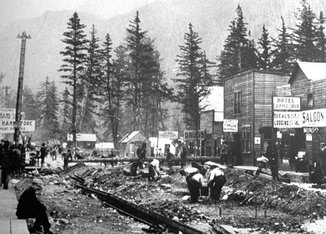
A gold mining town 1850-1852
A total of $2 billion worth of precious metal was extracted from the area during the Gold Rush, though after 1850 there was not much surface gold left, even though miners continued to arrive. Many ended up being employed by large companies who could afford hydraulic mining equipment to reach gold deeper below the surface. These companies made enormous profits ($81 million was made in 1852) but destroyed much of the region’s landscape. Many native people were also driven from their homeland, and there was tension between different nationalities.
After 1852, the amount of gold steadily decreased. California continued to grow, however, as more people still came to settle there. By the end of the decade the state’s population was 380,000. The Gold Rush made a huge impact on America’s economy and allowed California to become a free state, known of course as the “golden state”.

