Homestead Act
May 20, 1862
What did it do?
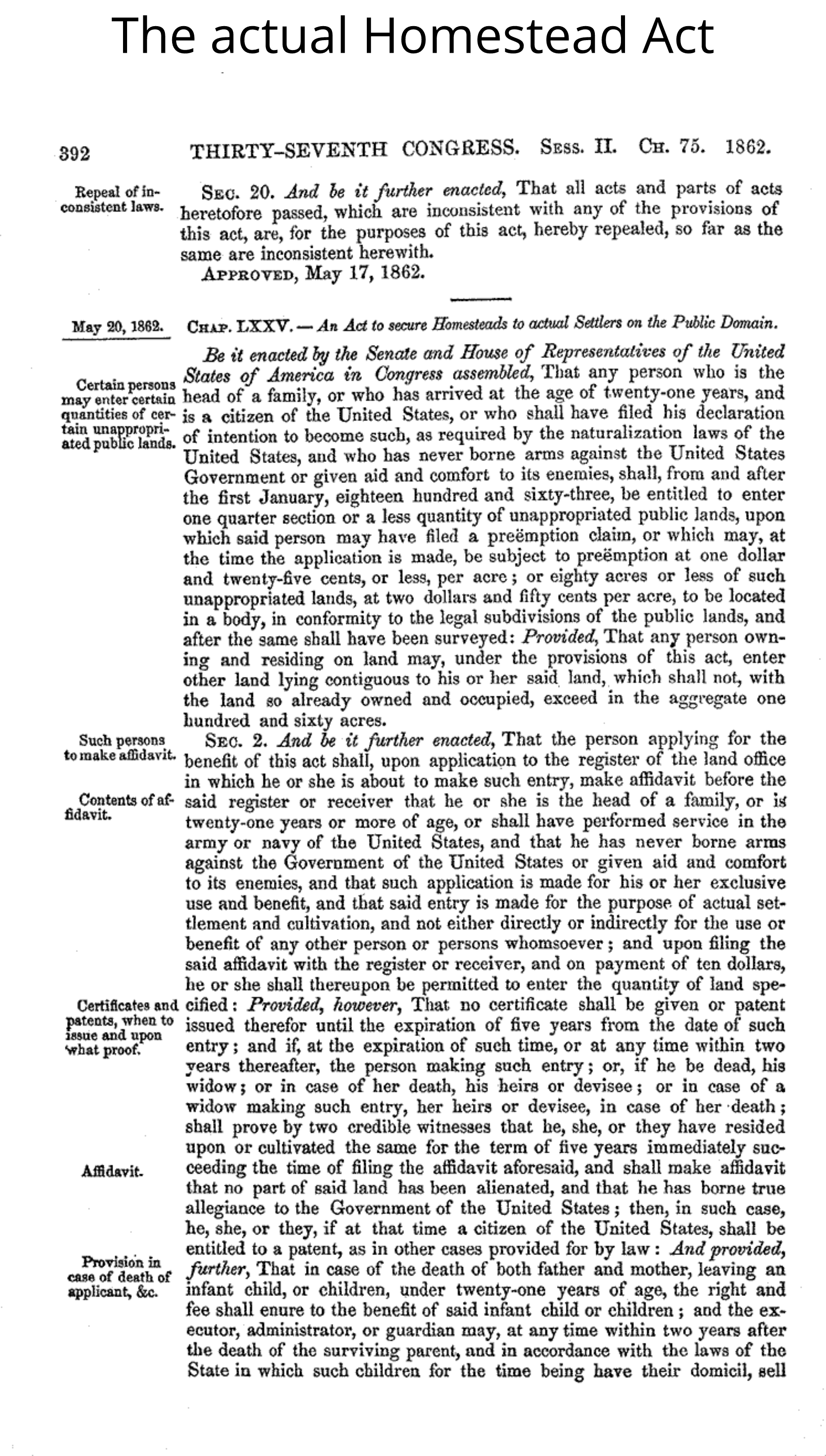
The Homestead Act granted Americans 160 acres (650,000 square metres) of public land for an extremely cheap price.
Why was it created?
It was created for to develop land, increase farming and make America an overall more attractive place to live. The Great Plains was a vast area of unused land, and the government wanted to accelerate growth in the area.
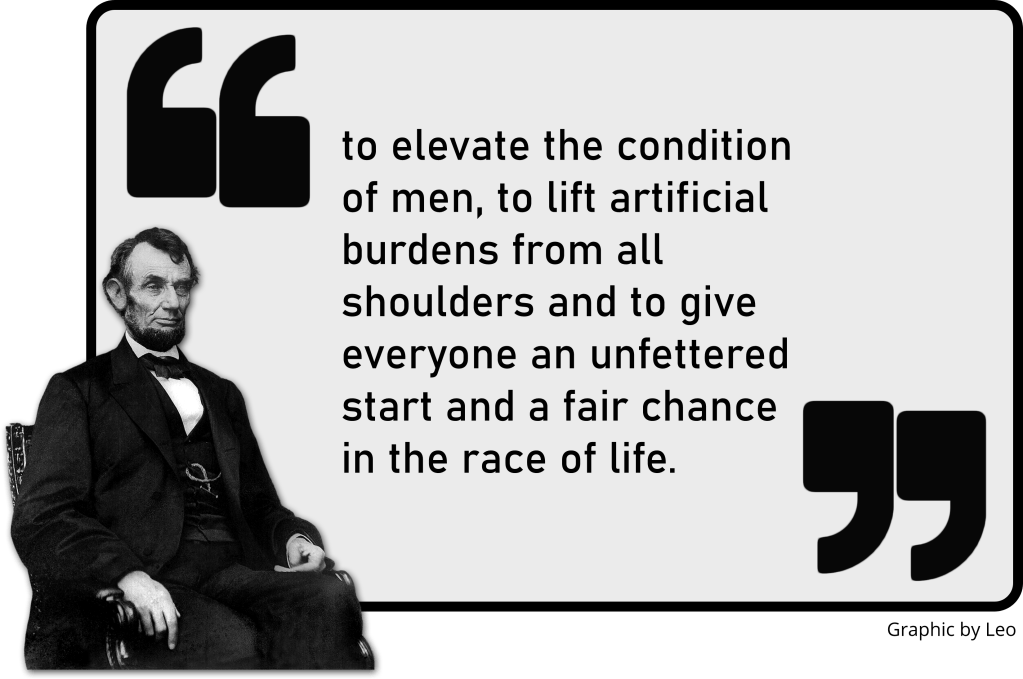
On July 4 1861, Lincoln said his aim was:
How did you apply?
You had to fit these criteria to apply:
| • Had to be either the head of a family or 21 years of age |
| • Had to be a U.S. citizen, or an immigrant with an application to become a citizen |
| • Had to certify you had never borne arms against the U.S |
| • Needed two neighbors or friends to confirm your statements were true |
| • Had to pay a filing fee of just $18 ($10 to make a temporary claim on the land, $2 for commission to the land agent and $6 final payment to receive an official patent on the land) |
| • To confirm the land as finally yours, you had to live for five years continuously on the land, build a home on it, farm the land and make improvements. |
What was the effect of the Act?
Thousands of people flocked to the Great Plains in order to take advantage of the free land. Before the Act ended in 1976, it had resulted in 10 percent of all U.S. land (270 million acres) being claimed and settled. It led to major improvements in rail lines, quickly growing populations, new towns and states. However, Native Americans were also forced from their lands and onto reservations to make way for new homesteaders.
Why was it so popular?
It was extremely popular as so many people could apply – people who before the Act would never have been allowed to own a homestead. This included freed slaves, new immigrants, single women and people of any race. People who had never owned land before, such as African Americans (who migrated from the South in their thousands), felt they finally had a chance to succeed in the US.
President John F Kennedy said in 1962:

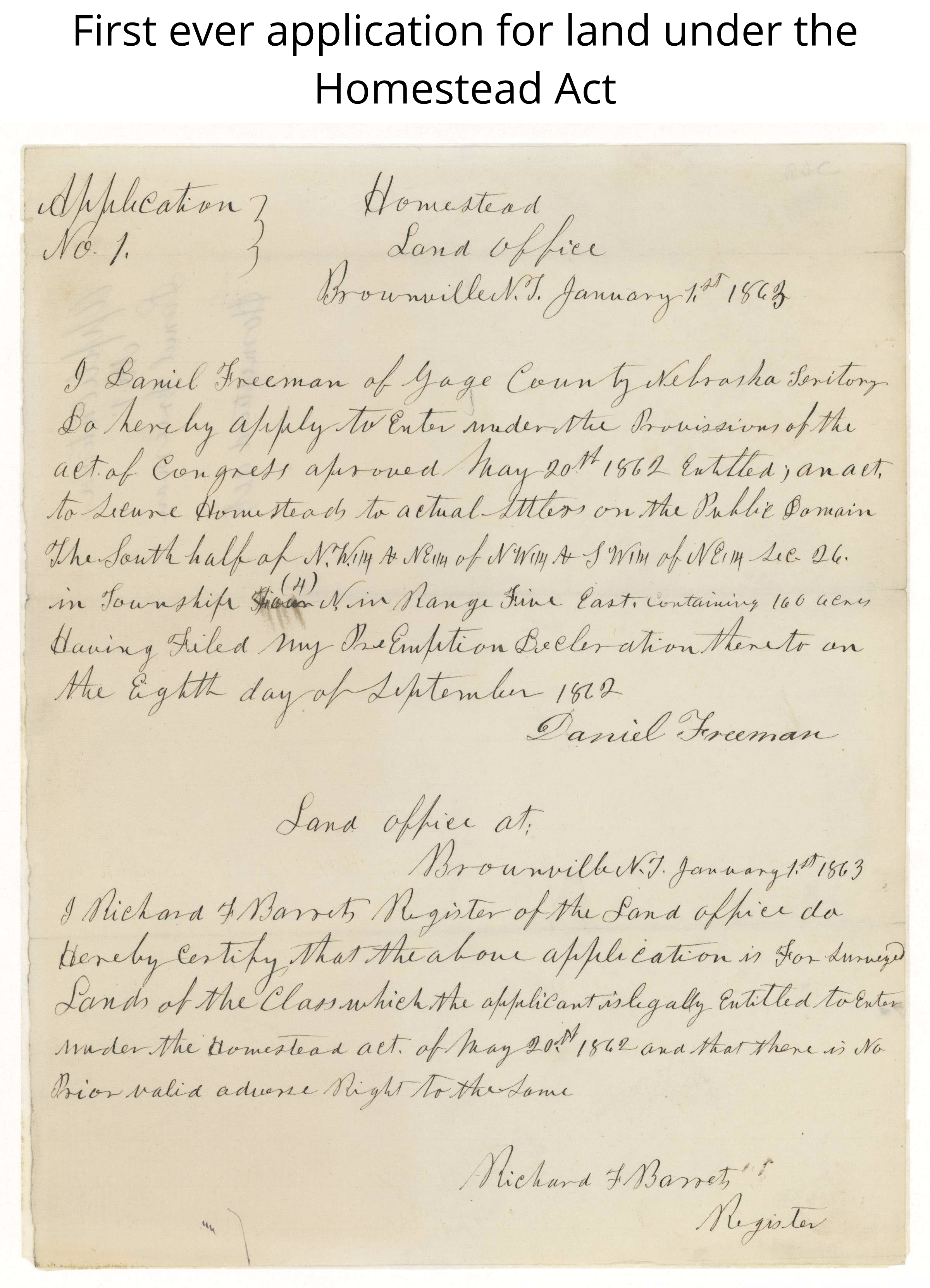
Sources
What were the problems with homesteading?
The Homestead Act looked good on paper, but the were many problems, mainly due to the great plains not really being suited to farming. This led to many homesteaders abandoning their claims well before the five-year period was over. Here are some of the main problems and what those determined to stay tried to do about them.
| Problems | Solutions | |
|---|---|---|
| The land was hard to work, and it was difficult to get started without good equipment, which people couldn’t afford. | Some people travelled around with ploughs at the start of the season and threshing machines at harvest time, and you could hire them for a few days. | |
| There were only 38 cm of rainfall in a year, plus very hot summers, which led to terrible droughts throughout the 1860s. These could also lead to fires. There were also very few streams for irrigating crops. | Farmers could invest in a well driller which allowed deep wells to be dug, reaching underground water. People had to adapt the type of crop they grew (like using a variety of wheat from Russia which grew in arid conditions instead of traditional wheat) Farmers also learned tricks to help, for example putting a layer of dust on the soil after rain, which stopped evaporation, or planting seeds deeper (using a seed drill) so they could reach moisture. | |
| The weather in winter was extreme too, with devastating storms, hail and ice that ruined crops. | Again, farmers had to adapt by planting hardy crops, and if they lost them, they just had to start again. | |
| Farmers could not grow enough on their farms to feed a family. | The government realised that 160 acres was not enough to sustain people. The Timber Culture Act of 1873 gave farmers another 160 acres for free if they grew some trees. | |
| There were huge plagues of insects, such as grasshoppers, which stripped whole fields of corn in seconds, and Colorado beetles, which destroyed potato crops. | Farmers just had to try to harvest as much as they could before crops were destroyed, and try again next year. But without modern insecticides this was a major problem. The government did, however, raise relief funds to help. | |
| There could be violent clashes with rival settlers or native americans, and bandits roamed around stealing horses. There was no established protection and people often lived in very remote areas, and could not get help easily. Everyone carried guns so violence was common. | Gradually law courts and sheriffs established law and order, especially as towns grew. When the area reached a population of 5,000, it became a territory, with locally-elected sheriffs. Some people set up their own vigilante groups to combat crime, though they could be as violent as those they opposed. | |
| There were not many trees on the Great Plains, which led to a lack of wood for: 1. Building houses 2. Burning for heat and cooking 3. Fences to keep cattle off crops | 1. Many people had to build houses out of blocks of earth. 2. People used alternatives such as dried buffalo dung for fuel, or twisted hay. 3. Farmers tried to grow more than they needed to allow for losses. After 1874, barbed wire had been invented, which was effective and easier than building fences. |
This humerous cartoon from 1887 shows the reality of what homesteading was like for many people.
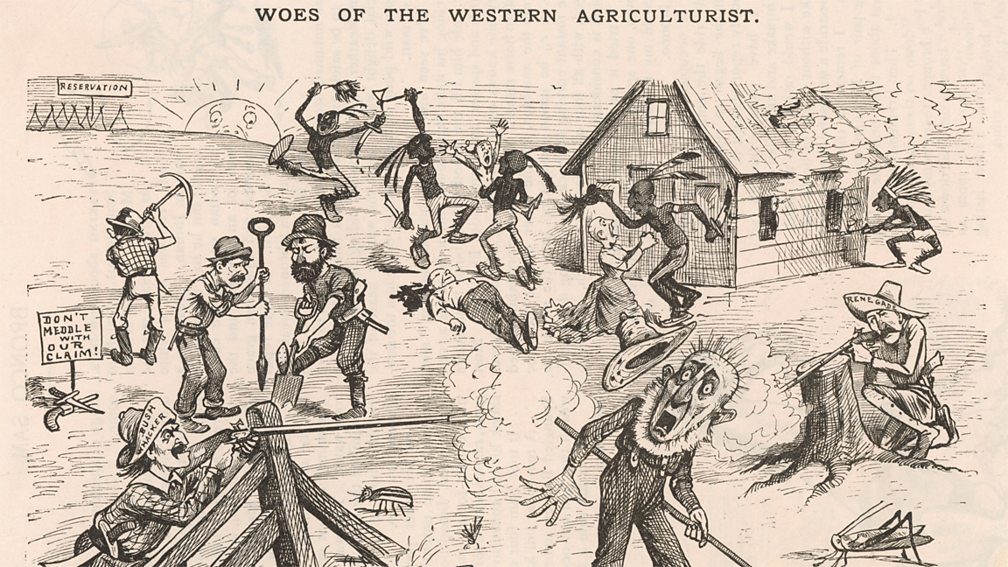
Posibly highly exaggerated, this cartoon shows all sorts of the problems homesteaders faced, including tensions between natives and the settlers, insects and tough land.
 Leo T
Leo T 